
This writing is dedicated to my cousin Brian K. who has often been a shining light in my life.

This article was written in response to a question posed to me by a friend. His question came as a response to an excerpt from the Tao Te Ching I posted on a social website which reads:
“Hope and fear are both phantoms
that arise from thinking of the self.
When we don’t see the self as self,
what do we have to fear?” (Tao Ch:13)1
After reading the excerpt my friend asked: “If we don’t see the self as self, then what are we?”
This question often comes to front and center when people reflect on their meditative practice. This is the beginning of the walk on a path that leads to spiritual and mental realization.
Who are we?
From the time of our conception we are formed by our social surroundings or what some call conditioned by our outer environment. The influence of our parents, or lack of parents, the influence of our siblings, the influence of our community, the churches we attended or did not attend, our teachers, mentors, civil authorities and political leaders, the movies we watch, the music we listen to, the books we read, the advertisement that we are bombarded with, basically everything in our outer environment, along with some personal choices, play apart in creating our personal identities.
If someone asks you who you are, how would you respond? I have heard people respond with reciting their name, “I am Jane Doe. I am a part of the Doe Family.” If they are at their work they may respond with their job title, “I’m a truck driver for Nestles.” If in a foreign country perhaps the response would be, “I’m an American.” At a sporting event the response may be, “I am a Blues fan.” In reference to a belief system one may respond, “I am a Christian” or, “I am an atheist”, etc. When we identify ourselves in this way we are speaking out of our personal histories exposing the influences from our past conditioning. In these histories is the story of the self.
These self identifiers can be known as “tags”. These tags come with mental attachments and learned patterns of thought. We cling to these patterns dearly because these patterns, in a large way, are us. As we cling to them, many are oblivious to the notion that these “tags” can be confining to our growth. By the time we are adults we are covered with so many tags, many of which we did not choose for ourselves, that we have smothered any true sense of who we really are. “Is this really me or is this who others convinced me that I am? Is there a genuine, pure me underneath all this?”
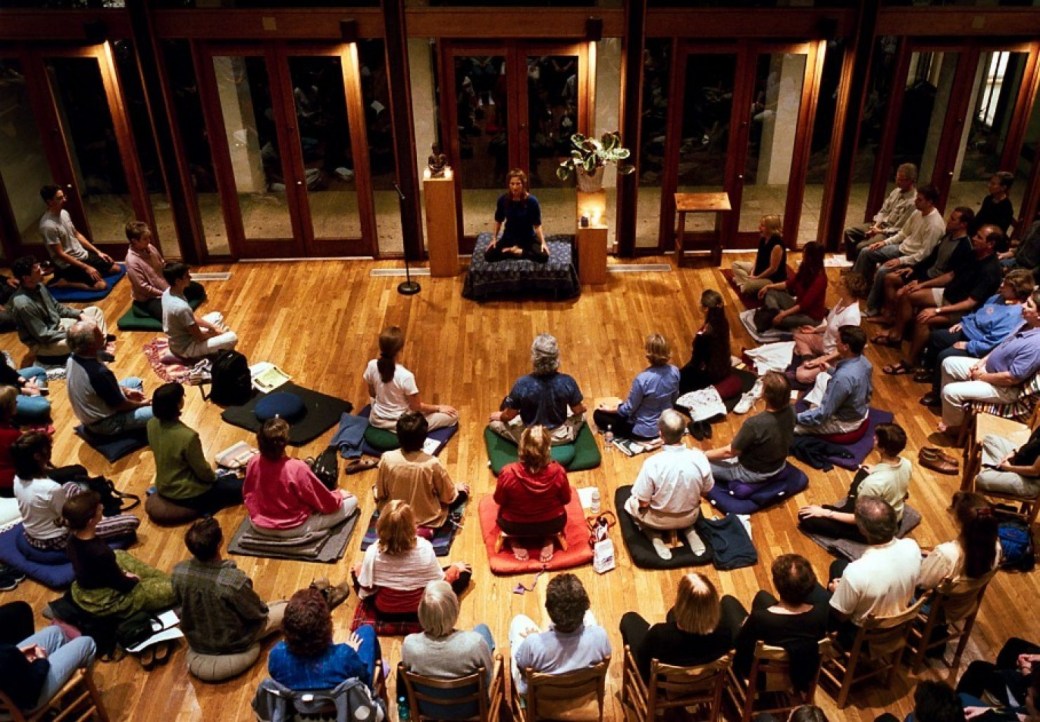
I often ask people within our meditation groups, “If you could swipe the mind clean of all past influences, family, country, religion, all of it, who would you be?” There must be something there because when you close your eyes and remove the thoughts from the mind something remains. What remains is the authentic you.
The authentication of Paige Bradley

The virtuoso sculptor Paige Bradley (pictured above) describes this in a fashion that beckons my humbleness. In an attempt to remove the confines of the conditioned perceptions of her past she shatters a sculpture that she had been working on for months. She began piecing the fragments back together resulting in a work of art that clearly displays the light of the pure self inside of her and each of us.
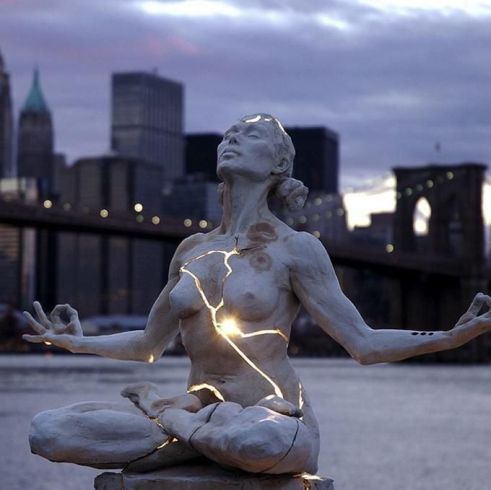
In her own poignant words she explains:
“From the moment we are born, the world tends to have a box already built for us to fit inside. Our umbilical cord never seems to be severed; we only find new needs to fill. If we disconnected and severed our attachments, would we shatter our confinements and expand beyond our shell? Would the world look different? Would we recognize ourselves? Are we the box that we are inside, and to be authentically ‘un-contained’ would we still be able to exist? This is the irony of containment. As long as we don’t push on the walls of our surroundings, we may never know how strong we really are.”
To view the original article and more about the Artist Paige Bradley click here .
Realizing who you are
Lao Tzu, in the scripture reading quoted above, is separating the ordinary egoic self from the genuine self. When one privileges the tags that compose our understanding of the self over our obvious connection to all life, the world, and the divine essence of our Source, we begin to lose our true sense of self. As the practice of mind clearing meditation becomes habitual you start to peel away these layers of attachments that previously defined you. Simultaneously you begin reformatting your mind in a way that dissolves negative thought patterns and continues to bring your awareness back to your connection with the “big picture” of life. The egoic self shrinks and the genuine self expands. In some cases during these meditative episodes you no longer “see the self as self” but experience your being as fussed with all else that is. This is what the Hindu scriptures call self-realization. Your thinking becomes less “me” centered or human centered and becomes Source centered. Hence, the stanza that completes chapter 13 of the Tao states:
“See the world as your self.
Have faith in the way things are.
Love the world as your self;
then you can care for all things.”1
In the Christian scriptures, Jesus addresses egoic or human centered thought quit plainly in Mathew’s gospel. In this story Jesus informs his followers that he soon will suffer and be killed at the hands of Jewish elders. Peter, in an inflation of the egoic self, criticizes Jesus and arrogantly proceeds to tell Jesus how God should be involved with His people. The passage that includes Peter’s rebuke is as follows:
“Then Peter took him aside and began to rebuke him, “God forbid, Lord! No such thing shall ever happen to you.” He turned and said to Peter, “Get behind me, Satan! You are an obstacle to me. You are thinking not as God does, but as human beings do.” (Mat 16:23-24 NAB)
Then Jesus returns to the other followers who were there and reminds them of the sentiments of Lao Tzu;
“Whoever wishes to come after me must deny himself”
Please keep in mind that Lao Tzu is not preoccupied with judgments of right or wrong. Lao Tzu’s focus is psychological. He is pointing to that which happens in the mind that robs a person of contentment and peace. Is it wrong to identify ourselves by our family name or by our country of origin? Not necessarily. If we could retrace our family lineage back to before the beginning of time there also would be our Source.
I will close with Chapter 16 of the Tao Te Ching. Perhaps this will put this writing in perspective:
“Empty your mind of all thoughts.
Let your heart be at peace.
Watch the turmoil of beings,
but contemplate their return.
Each separate being in the universe
returns to the common source.
Returning to the source is serenity.
If you don’t realize the source,
you stumble in confusion and sorrow.
When you realize where you come from,
you naturally become tolerant,
disinterested, amused,
kindhearted as a grandmother,
dignified as a king.
Immersed in the wonder of the Tao,
you can deal with whatever life brings you,
and when death comes, you are ready.”1
Notes:
1.All quotes from the Tao Te Ching have been retrieved from: Tao Te Ching: A new English Translation, Stephen Mitchell, Harper Collins, 2009