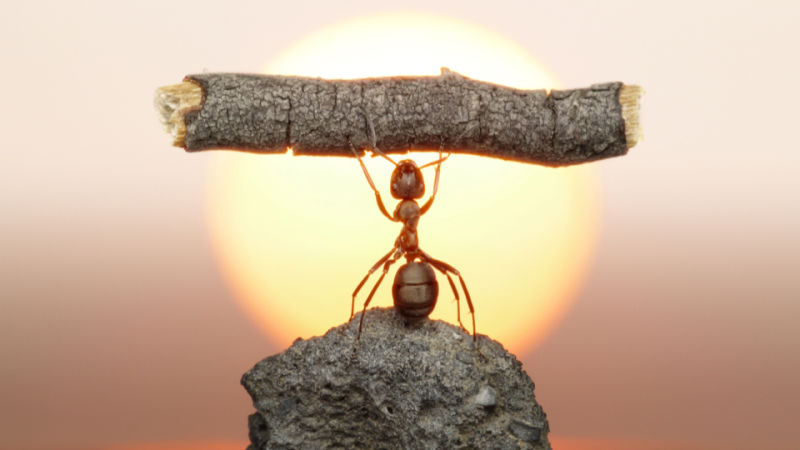
On one day in May I meditated in the late morning as the construction work that I was scheduled to do that day was called off. After meditation I went outside with my niece’s dog so that she could run around the back yard as I drank a cup of coffee. I was in an extreme state of awareness. While sitting on the brick patio I noticed a small ant that was diligently carrying what looked like a flake of coal about the size of a clipped finger nail. The ant was struggling in getting this large piece across the bricks to her destination. There was a slight wind. The force of the breeze against the flat side of the flake accompanied with the weight and shape of the flake itself was causing the ant to spin around on occasion in order to hang on to her new found necessity. After the spin, the ant would stagger a bit while resetting herself on the path of her intention. As I watched the ant I felt connected to her in some way. I wondered what made me think in times past that what I was doing was more important than what the ant was doing on the occasions when we would cross paths. Both of our lives were necessary for the positive development of the world ecosystems. At the moment this animal seemed to be exercising more positive coordinated evolvement than I was.
As I watched this scene I recalled a sermon I had heard years before from a Catholic priest in my home town during a Sunday service. In the pastors talk he claimed the actions of the Buddha were “retarded” because he had read stories where the Gautama would walk with his head bowed being careful to step aside when he would come upon ants that where in his path. This enlightened spiritual master practiced such a reverence for all life that he did not want to disrupt the ants.
I had a difficult time reconciling the words of the priest in my current observation of the ant. The ant was tenacious in crossing wide crevices in the brick with flake in her hands. The ant did not seem to have much concern about what I was doing as she moved toward her colony. In a comparable size to weight ratio the ant did more in 5 minutes than I could have done in 4 hours with three men and a crane. If ants think at all like humans then this ant obviously experienced conscious mind activity in that she could exercise memory functions returning from whence she came. After marveling at the ant’s ability and finishing my coffee, I decided to test the priest theory about the actions of the 6 century BCE Indian sage whom over 500 million living humans claim to be one of the wisest men to ever walk the face of the planet. I spent some time researching ants.
The first study I came upon was from a professor at Ohio State University in regards to mentally grasping an ant’s physical strength. His team found that some ant bodies can with stand more than 3500 times their weight in pressure before they are crushed. To give you an idea of the weight to pressure ration this would be the same as placing a 3600SF, 2 story house on the back of a 170lb man before their neck would break.1 Ok, their physically strong. What about their longevity? Queen Carpenter ants can live up to 10 years. Some classes of ants can live for 30 years.2
What about their ability to function and evolve in their environment which is an accurate mark of intelligence? The study of other animals who don’t share a lot in common with human beings has been detoured in a large way due to our persistent, debilitating, man centered thought process. Often humans’ only understanding of intelligence is composed of perceiving the physical world as humans do. Ants display complex and intelligent behavior even by human standards. They navigate long distances, communicate with each other, avoid predators, display courtship, care for their young, similar to many mammals. Research that came out of the University of Sussex determined that when it comes to a sense of direction and the ability to move around in their environment, “ants use a variety of cues to navigate, such as sun position, polarized light patterns, visual panoramas, gradient of odors, wind direction, slope, ground texture, step-counting… and more. Indeed, the list of cues ants can utilize for navigation is probably greater than for humans.” The study goes on to conclude that in general the intricacies of ant brains are far too complex for humans to fully understand any time soon.3
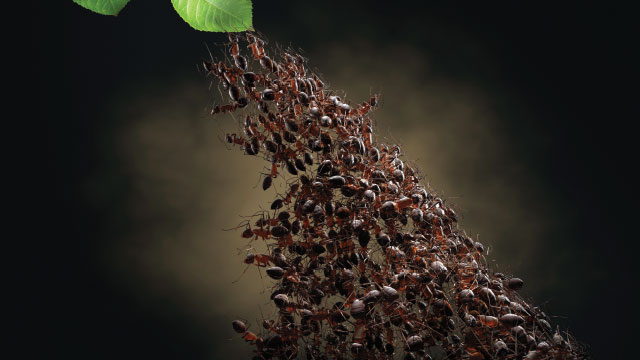
What about evolution? Ted Schultz, Curator of Hymenoptera (Ants) for the Smithsonian Institute has been studying these extraordinary animals for over 30 years. In reference to ant evolution he stated that, “ants are arguably the greatest success story in the history of terrestrial metazoa (multicellular animals on the earth)”, this includes humans.4 This indicates that ants are positively evolving at a much greater rate than humans. Ants have been around for over 65 million years and survived mass extinction events. The oldest remains discovered called “human” only date back 195,000 years. On average ants monopolize over 15-20% percent of their habitat with an estimated population of around 10 quadrillion. 5 That’s 1.4 million ants for each human that occupies the same planetary space. Ants will work in coordination with other species of ants. They domesticate multiple types of fungi, their food source, like we grow plants and flowers in our living spaces. They will choose to grow certain fungi that are most beneficial for their nourishment and frequently transfer these types to other species. When ant habitats have been devastated by natural causes’ colonies have been known to join a neighboring colony and work in cooperation in a common garden.6
In some ways, many humans simply haven’t evolved to the equal intelligence level of ants. This is obvious by the fact that humans spend 1.7 trillion dollars on tools, training, and equipment, which destroys other humans and their habitats.7 Less than 2% of that amount would feed the 7.5 million humans who starve to death each year.8 I could not find any information that stated that ants destroy other ant habitats. Humans who inhabit many parts of the globe are trained from the time they are young that non-edible materials such as gold, silver, platinum, and paper with inked impressions of historical figures, are more important than other humans and in some cases more important than life itself. There have been countless documented incidences where people were completely willing to sacrifice their own lives for these materials which had no human physically sustaining value. Ants don’t typically involve themselves in activities such as these that are considered “de-evolutionary”.
Is it possible that the Buddha knew something that the priest didn’t? Perhaps the Spiritual Teacher was aware of the important role that ants play in maintaining a healthy planet. By digging tunnels ants aerate the soil allowing better water flow and bringing nutrients closer to the surface for vegetation. It is estimated that ants move over 50 tons of dirt per year in one square mile.9 Ants increase the dispersal, survival, and germination rates, of seeds by carrying them to new habitats away from seed eaters (birds) and drought. Ants prey on the eggs and larvae of other insects such as flies, cock roaches, bed bugs, and fleas. And this is only a few of the positive aspects of ants. The diversity of total ant species with in an ecosystem can be an indicator of overall environmental health. This contributes to the health of all plant, fungi, and animals (including humans), that share the environment.10
In regards to ants I am going to have to go with the Buddha on this. I remember some of a passage I read from the Pali Cannon that was attributed to the Buddha, in paraphrase it goes something like, “Believe nothing on the sole authority of your masters and priest. After examination, believe what you have tested and found to be reasonable. Then, act accordingly.”
Notes:
- (Carlos Castro, Journal of Biomechanics, Vol.47 Is.2, Pg 497-504, 1/22/14;
Weight of house, http://hunterthehousehunter.com/tag/how-much-does-a-house-weigh/)
- (Steph Unna, Systems Biology PhD Student at the Sainsbury Laboratory, Cambridge University, http://biology.stackexchange.com/questions/2785/why-do-ants-live-so-long, 06/30/12)
- (Antoine Wystrach, Animal Behavior – University of Sussex, The Conversation, 09/03/13)
- (Proceedings of the National Academy of Sciences of the United States of America, vol.97 No.26, Ted R. Schultz, 14028–14029, doi: 10.1073/pnas.011513798)
- (Robert Gonzalez, http://io9.gizmodo.com/5880539/10-frightening-facts-you-probably-didn’t-know-about-ants)
- (University of Texas, Austin- Ant Studies, http://www.uni-konstanz.de/FuF/Bio/neuroetho/index/Adams%20et%20al.%202000a.pdf)
- (World military expenditure in 2012 is estimated to have reached $7.756 Trillion; http://www.globalissues.org/article/75/world-military-spending.
- (United Nations Estimate, http://borgenproject.org/the-cost-to-end-world-hunger/)
- (http://ant/ark.net/ant-facts/)
10.( Corrie Moreau, Ant Blog 08/26/12, http://www.antweb.org/antblog/2012/08/what-good-are-ants-david-panama-city-florida-usa.html)
- Buddha recitation, Pearls of wisdom, (http://www.sapphyr.net/buddhist/buddhist-quotes.htm)